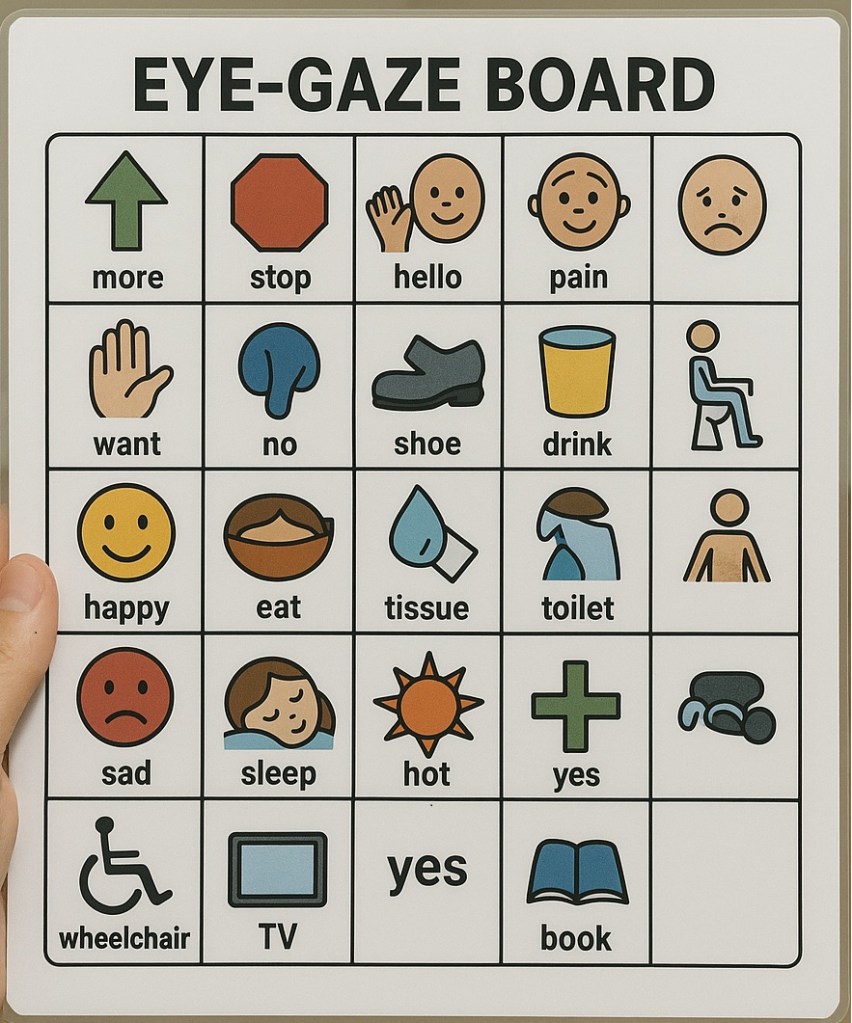
Eye-gaze boards (also known as eye-pointing boards or communication boards) are low-tech assistive communication tools designed primarily for individuals with significant physical disabilities or speech impairments. These boards allow a person to communicate by using only their eye movements.
What is an Eye-Gaze Board?
An eye-gaze board is a physical board—usually made of clear acrylic, cardboard, or laminated paper—with symbols, letters, words, or pictures arranged on it. A user indicates a choice or communicates a message by looking directly at a specific item on the board, and a communication partner interprets where the user is looking.
Types of Eye-Gaze Boards:
- Clear Eye-Gaze Frames (Transparent Boards):
- Made of clear plastic with images, letters, or words around the edge.
- The partner looks through the transparent board to see where the user is looking.
- Non-Transparent Boards:
- Items are arranged on a flat board or sheet.
- The observer watches the user’s eyes to detect which item they focus on.
- Thematic Boards:
- Designed for specific scenarios (e.g., food choices, pain scale, emotions).
Who Uses Eye-Gaze Boards?
- Individuals with Cerebral Palsy
- People with Motor Neuron Disease (ALS)
- Individuals recovering from stroke or brain injury
- Children with non-verbal autism
- Anyone with limited or no motor control but with good eye movement control
Key Benefits:
- No power needed – ideal for low-tech or backup communication
- Customizable – boards can be tailored to individual needs
- Portable and affordable
- Encourages independence and participation
Limitations:
- Requires a trained communication partner
- Eye-pointing may be hard to interpret without experience
- Limited vocabulary (compared to high-tech AAC devices)
- Not suitable for users with impaired vision or inconsistent eye movement
Use in Practice:
Eye-gaze boards are often used in:
- Speech and language therapy
- Special education
- Home care settings
- As a backup communication method for users of high-tech eye-tracking systems
 Maurvik