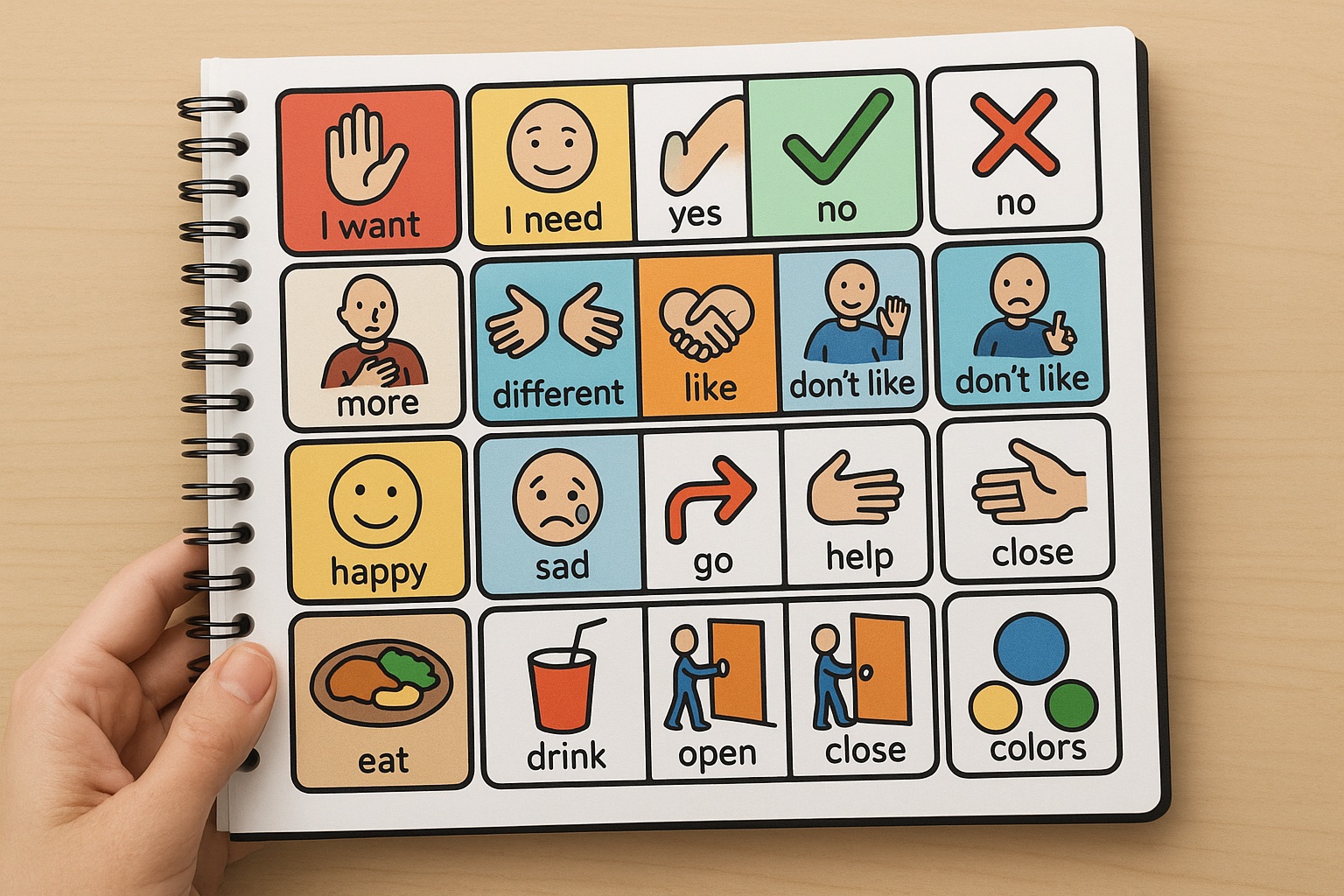
Definition: Communication boards or books are low-tech AAC tools that display symbols, words, pictures, or letters to help individuals express their needs, thoughts, and emotions. Users point to or gaze at images or text to communicate.
🔹 Types of Communication Boards/Books:
- Static Boards:
- Fixed layout with symbols or words printed on paper or laminated sheets.
- Common themes include emotions, food, daily activities, people, and places.
- Flip Books or Communication Books:
- Multi-page tools organized by topic or context (e.g., school, home, play).
- Often used by individuals with complex communication needs.
- Alphabet Boards:
- Contain letters of the alphabet for spelling words—useful for literate users.
- Core Vocabulary Boards:
- Focus on high-frequency, versatile words like “want,” “go,” “more,” “help.”
- Designed to build language skills and support sentence formation.
🔹 Users:
- Individuals with:
- Autism Spectrum Disorder (ASD)
- Cerebral Palsy
- Down Syndrome
- Aphasia
- Other speech and language impairments
🔹 Advantages:
- Low Cost & Accessible: Requires no batteries or technology.
- Customizable: Can be tailored to a user’s specific environment and needs.
- Durable: Laminated or printed on sturdy material for long-term use.
- Always Available: No risk of software crashes or charging needs.
🔹 Limitations:
- Slower Communication: Compared to verbal speech or high-tech AAC devices.
- Limited Vocabulary: Users may be restricted by the symbols available.
- Dependence on Motor Skills: Requires pointing, eye-gazing, or scanning ability.
🔹 Best Practices:
- Use clear visuals and organized layouts.
- Incorporate both core and fringe vocabulary.
- Train both the user and communication partners on how to use the tool effectively.
- Pair with verbal speech or gestures when possible to reinforce meaning.
 Maurvik